Friday, 29 January 2021

REMNANTS OF ONE OFF’S HOLIDAY SHOW

                                                                                                  Peter Ngugi's 'Black book clique' at One Off
 

By Margaretta wa Gacheru (published January 15, 2021)

One Off Art Gallery had extended its Christmas show through mid-January, so you can still go (by appointment) and see one of the most colorful and eclectic exhibitions that Carol Lees had curated in 2020.

The pandemic hasn’t made life easy for art galleries, given the lockdowns and social distancing protocols. Nonetheless, One Off was able to stay open and assemble a dazzling array of works by artists for its post-Christmas show. It includes works by everyone from Peter Ngugi, Michael Musyoka, Beatrice Wanjiku, and Jackson Wanjau to David Thuku, Sophie Walbeoffe, Peterson Kamwathi, and Fitsum Berhe among others.

It’s an exhibition easily described as stunning, and not just because of the number of new paintings on display. It’s also because of the fresh themes, colors, and designs employed by the artists.

                                     Fitsum Berhe's 'From the tapestries of our shared histories'

Take, for instance, Peter Ngugi’s painting, ‘Small Book Clique’, with its backdrop design of five-liter sized containers of popular cooking oil.

“Peter said that one kind of cooking oil is the item most frequently bought at the local kiosk, and paid for using a small book,” says Carol Lees speaking to Business Daily moments before a torrential rainstorm hit the gallery.

Presumably, it’s the kiosk owner mama, dressed in a bright multicolored kitenge dress who is in the foreground of Ngugi’s painting.  She stands next to two casually dressed men, while all three have been drawn in nearly life-sized forms. And like virtually all the characters in Ngugi’s community-based paintings, none have facial features, only black silhouetted heads.

But the blackened faces do not distract from the naturalistic gestures of the otherwise colorful figures in Ngugi’s art.

                                                          Michael Musyoka's Time XIII 

Still, if you don’t live in Nairobi’s suburbs, you might not know that the small book serves as a sort of credit card and is popular among the local population.

Another stunner of a piece in One Off’s post-Christmas show is one by Fitsum entitled ‘From tapestries of our shared histories VIII’. He has several portraits in the exhibition, both in the Loft and Stable gallery. But the one I found most arresting was his portrait of a woman whose face was shaded in cheerful hues and encircled by floral designs that Carol explained were replicas of those discovered on ancient Chinese porcelain that had washed up on our Coastal shores over time.

And like Ngugi’s painting, one finds in Fitsum’s piece, the design elements are just as important to the total impact of the painting as the figure (or figures) in the foreground.

Human figures are pervasive in much of the One-Off show. There are classic portraits of Kenyans by Olivia Prendergast, so-called ‘Savage Beast’ men in Kamwathi’s drawings, multiple running men in Musyoka’s latest interpretation of ‘Time’ as a finite human constraint, and in sculptures by Jackson Wanjau and Bertiers Mbatia.


                                            Michael Musyoka with artworks from his 'Time' series at his Brush tu studio

Beatrice Wanjiku takes a totally new look at the human form. Her latest oil paintings on canvas depict internal organs and skeletal structures (like a rib cage) in monochromatic hues. Still semi-abstract in design, Beatrice’s works depart from her previous focus on blackened shapes. Now she experiments with much brighter colors and less abstract forms. Nonetheless, one still feels the organs have a deeper, more symbolic significance that runs within the inner features of the works.

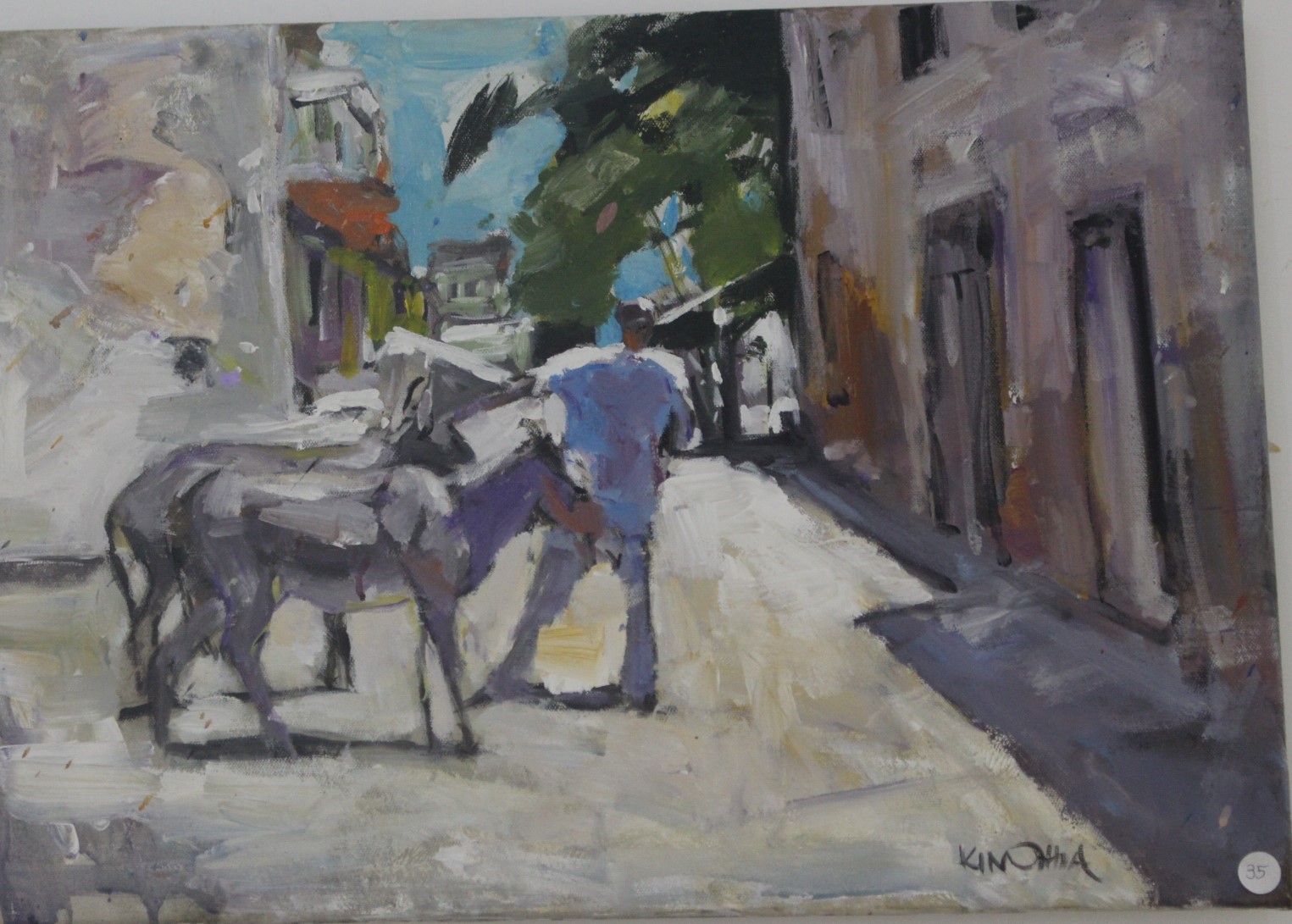
Sophie Walbeoffe’s ‘Lamu’ coastline takes us out of the realm of human conjecture and into bright equatorial sunlight where the artist has spent time painting many facets of the village and preparing an elegant book filled with glowing images of one of Kenya’s most idyllic spots. Lamu is still a place where cars are forbidden, and dhows and donkeys remain the most prevalent modes of public transport.


One painting that sends an attractive yet sobering message is by David Thuku whose art has been exploring the theme of consumerism and its impact on the individual for some time. But unlike his previous visual commentaries on the topic, Thuku doesn’t examine the impact on individuals. Rather, his ‘portrait’ is of a tattered piece of packaging, symbolic of the end of an era. For the pandemic has certainly constrained consumers’ ability to shop. What remains is the trash, including tattered pieces of plastic packaging.

Don’t be surprised that Thuku’s art has taken such a turn. He’s a keen observer of social change; and like so many local artists, he has drawn inspiration from the challenges we have encountered in this pandemic age.

Friday, 25 December 2020

ARTISTS’ OPEN HOUSE ATTRACTS SHOPPERS OVER JAMHURI WEEKEND

            Boniface Maina's art was displayed at Brush tu's Open House in December, 2020


BY Margaretta wa Gacheru (published December 25, 2020)

Having an Open House implies being so transparent and welcoming that you are happy to invite any and everyone into your home. Even during a pandemic, the Brush tu Art Collective was willing to declare their open invitation on Instagram to come and see some of the latest artwork Brush tu artists have conceived, mostly since March when the COVID shutdowns first hit.

For instance, Boniface Maina, one of the co-founders of the Collective (with Michael Musyoka and David Thuku) just recently had a solo exhibition at Circle Art Gallery (where masks and social distancing were imperatives). Yet he presented four of his post-exhibition paintings, each one placing Maina’s avatar in spaces where COVID hasn’t reached and life is relaxed. His only concern is that two of his paintings are entitled ‘Fantasy’, yet most Kenyans know the pandemic is neither a fantasy nor a hoax. So those paintings seem almost otherworldly since the avatar looks oblivious to the viral threat.


                                                                    Boni Maina's art at Brush Tu Open House

Among the other Brush tu artists who have been painting up a storm since the shutdowns kept them at home is Sebawali Sio who has brought several of her latest glass-on-glass paintings to display during the group’s Open House weekend.

“But we’re likely to keep the exhibition open for another week or two since many people have said they want to see our work but don’t want to be around crowds,” Sebawali tells Business Daily. That’s a good sign since there are lots of red ‘sold’ stickers on the art, but still, there are a few visible price tags, meaning works are still there to be sold.

Peteros Ndunde is among those artists whose paintings have red stickers, while Maina also had a few. (The rest of the reds are scattered all around the studio.) Fortunately, Peteros promised interested parties that he would bring more of his new paintings early next week to replace those already sold.

But while the new owners of Peteros’ works agreed to leave their art at the studio for others to see the subtle new developments in his style, Lincoln Mwangi’s clients had other plans. They bought nearly all the young painter’s paintings shorter after the doors opened for the artists’ Jamhuri weekend event. But they were also quick to lift Lincoln’s artworks off the wall and quietly disappeared, leaving just one of his paintings and a long bare wall. The artist wasn’t disappointed about the sales but he was already hearing from unhappy shoppers who wanted to see and potentially buy more of his art.

One of Brush tu regulars who did not disappoint was Abdul Kiprop. He had a whole wall-like panel filled with his COVIS Mask prints made with the printing press that the artist made from scratch. Having come to Brush tu with the intention of becoming a painter, Abdul attended several print workshops given through Brush tu by master printers like Peterson Kamwathi and Thom Ogonga. He was wholly hooked on the art of printmaking after that. But as he was taught on other people’s presses, he realized he had no choice but to make his own, which he did! Now it’s available for use by all the Brush tu artists and friends who want to experiment with printing.

That air of openness and sharing is the ethos that has been a part of Brush tu’s appeal from the outset. It is also one reason the group has had so many interns arriving from various art institutions, both local and European. Most recently, photographer and art blogger Emmaus Kimani took part in a German cultural exchange program that took him to Berlin initially for three months. “But then, when the pandemic hit, I had to remain in Germany another four months,” says Emmaus who also had a chance to visit Hamburg where he met up with fellow Kenyan artist, Nicholas ‘Nicomambo’ Odhiambo who is currently studying fine art at the university there.

Emmaus also had a display table set up at Brush tu where the public could view an abundance of his photographs printed as post cards and computer mouse pads (but equally frameable). This intrepid camera man takes photos wherever he goes, both locally and overseas. In Germany, he was big on shooting skyscapes and other artful images.

Other Brush tu artists who have works on display included sculptor Boniface Kimani, Munene Kariuki, newcomer Husna Nyathira Ismail, Waweru Gichuhi and Moira Bushkimani whose paper-cut paintings were in high demand even without price tags on them.

BY Margaretta wa Gacheru (published December 25, 2020)

Having an Open House implies being so transparent and welcoming that you are happy to invite any and everyone into your home. Even during a pandemic, the Brush tu Art Collective was willing to declare their open invitation on Instagram to come and see some of the latest artwork Brush tu artists have conceived, mostly since March when the COVID shutdowns first hit.

For instance, Boniface Maina, one of the co-founders of the Collective (with Michael Musyoka and David Thuku) just recently had a solo exhibition at Circle Art Gallery (where masks and social distancing were imperatives). Yet he presented four of his post-exhibition paintings, each one placing Maina’s avatar in spaces where COVID hasn’t reached and life is relaxed. His only concern is that two of his paintings are entitled ‘Fantasy’, yet most Kenyans know the pandemic is neither a fantasy nor a hoax. So those paintings seem almost otherworldly since the avatar looks oblivious to the viral threat.

Among the other Brush tu artists who have been painting up a storm since the shutdowns kept them at home is Sebawali Sio who has brought several of her latest glass-on-glass paintings to display during the group’s Open House weekend.

“But we’re likely to keep the exhibition open for another week or two since many people have said they want to see our work but don’t want to be around crowds,” Sebawali tells Business Daily. That’s a good sign since there are lots of red ‘sold’ stickers on the art, but still, there are a few visible price tags, meaning works are still there to be sold.

Peteros Ndunde is among those artists whose paintings have red stickers, while Maina also had a few. (The rest of the reds are scattered all around the studio.) Fortunately, Peteros promised interested parties that he would bring more of his new paintings early next week to replace those already sold.

But while the new owners of Peteros’ works agreed to leave their art at the studio for others to see the subtle new developments in his style, Lincoln Mwangi’s clients had other plans. They bought nearly all the young painter’s paintings shorter after the doors opened for the artists’ Jamhuri weekend event. But they were also quick to lift Lincoln’s artworks off the wall and quietly disappeared, leaving just one of his paintings and a long bare wall. The artist wasn’t disappointed about the sales but he was already hearing from unhappy shoppers who wanted to see and potentially buy more of his art.

One of Brush tu regulars who did not disappoint was Abdul Kiprop. He had a whole wall-like panel filled with his COVIS Mask prints made with the printing press that the artist made from scratch. Having come to Brush tu with the intention of becoming a painter, Abdul attended several print workshops given through Brush tu by master printers like Peterson Kamwathi and Thom Ogonga. He was wholly hooked on the art of printmaking after that. But as he was taught on other people’s presses, he realized he had no choice but to make his own, which he did! Now it’s available for use by all the Brush tu artists and friends who want to experiment with printing.

That air of openness and sharing is the ethos that has been a part of Brush tu’s appeal from the outset. It is also one reason the group has had so many interns arriving from various art institutions, both local and European. Most recently, photographer and art blogger Emmaus Kimani took part in a German cultural exchange program that took him to Berlin initially for three months. “But then, when the pandemic hit, I had to remain in Germany another four months,” says Emmaus who also had a chance to visit Hamburg where he met up with fellow Kenyan artist, Nicholas ‘Nicomambo’ Odhiambo who is currently studying fine art at the university there.

Emmaus also had a display table set up at Brush tu where the public could view an abundance of his photographs printed as post cards and computer mouse pads (but equally frameable). This intrepid camera man takes photos wherever he goes, both locally and overseas. In Germany, he was big on shooting skyscapes and other artful images.

Other Brush tu artists who have works on display included sculptor Boniface Kimani, Munene Kariuki, newcomer Husna Nyathira Ismail, Waweru Gichuhi and Moira Bushkimani whose paper-cut paintings were in high demand even without price tags on them.

NEW GALLERY OPENED BY KENYAN PAINTER IN ROSLYN

By Margaretta wa Gacheru (composed December 2020)

Patrick Kinuthia opened his new Roweinay Gallery last August with little or no fanfare. 

Yet who would deny that his move from his home studio in Migaa village, Kikuyu County into the upmarket Roslyn Riviera mall isn’t a major event in Kenya’s regional art world?

Patrick isn’t a Kenyan artist who’s inclined to toot his own horn or to make a spectacle of himself. He prefers to let his paintings speak for themselves. And indeed, they have over the years when he’s exhibited everywhere from the Dusit 2 Hotel, Village Market, Sarang Art and Banana Hill Art Galleries to the Tribal Art Gallery, United Nations Recreation Centre, Little Art Gallery and Michael Joseph Centre at Safaricom.

He’s been an artist ‘on fire’ for years, painting series of subjects that range from portraits and landscapes to local market scenes and Swahili doors that he’s seen in Mombasa’s Old Town. One of the country’s most prolific artists, Patrick is probably best known for his expressionist portraits of beautiful African women, some derived from his vivid imagination, others from any number of Kenya’s 43 communities.

But once he got commissioned by ICRAF, (now the World Agro-Forestry Centre) to paint local landscapes back in 2013, his impressionist visions of Kenya’s natural spaces have won him many more admirers.

Patrick claims he came to Roslyn Riviera for ‘convenience’s sake’.

“It was difficult for many of my clients to find my home in Kikuyu,” says the artist. “So I felt I needed to find a base more centrally located and easier for people to find my work,” he adds.

Having a gallery of his own also means he is now able to exhibit his latest works as well as some early ones. That includes remnants of series such as his ‘Gabra man’, (from his indigenous people phase), his Wangigi Market, (from his ‘African Markets’ series), and even from his more recent ‘African Garment series’ which was so well received that he decided to replicate several of them, only now as miniature works.

Occupying the space most recently held by One Off Gallery which opened and closed its Annex several months back, Patrick isn’t only planning to exhibit his art alone.

“I’m currently showing works by two local artists, Kennedy Kinyua and Njeri Kinuthia (no relation) who is a student of mine,” he says. “But I am open to the idea of exhibiting other artists’ works. In fact, I plan to give at least one wall [near the gallery entrance] to display other artists,” he adds.

What’s more, Patrick intends to run artists’ workshops in the gallery which got its name, roweinay, from the Kikuyu word meaning ‘river’. “The Ruaka river is just behind us,” says the man who has painted many Kenyan rivers, streams, and lakes. Two of them, Lakes Naivasha and Nakuru, are on display in the gallery right now.

Patrick has always been an independent spirt. He has also been keen on art from his youth. He grew up with a father who so loved the arts that he founded his own mobile cinema company and showed films all over Eastlands estates and beyond. But Patrick’s dad also appreciated the visual arts so much that he hired a professional artist from Pakistan named Rafiq Mohammed to paint advertising posters and murals promoting his Citizen Cinema company.

Nonetheless, Patrick’s father originally wanted his son to study accounting, which he did briefly after graduating from Hospital Hill School where he’d studied art throughout secondary (and primary) school. But once he made clear to his dad that accounts were not for him, Patrick went to work with his elder, painting under the tutelage of Rafiq.

“Rafiq was a meticulous portrait artist who also painted beautiful landscapes,”” recalls Patrick. “My father once commissioned him to paint all the African leaders of that time,” he adds, noting that he and Rafiq painted ‘poster art’ of everyone from Chuck Norris and Sylvester Stallone to sundry Chinese karate stars.

But after four years apprenticing with the Pakistani, Patrick went to study graphic design at the Kenya Polytechnic (now Technical University). From there, he got a job with Metal Box in Thika doing graphic design. But this too did not satisfy Patrick’s desire to get to work on his own. And that is what he’s been doing ever since.

Patrick admits he ‘went out on a limb’ when he opened the gallery. But being among the few Kenyan gallerist-painters, I’m inclined to believe his new initiative will succeed.

AN ONLINE AFRICAN MUSEUM COMING SOON

                                                                       Woodabe men's Courting Competition

By Margaretta wa Gacheru (composed Christmas 2020)

Photographers Carol Beckwith and Angela Fisher first met right here in Nairobi at the African Heritage Pan African Gallery more than 40 years ago.

Both artists, one from America, the other from Australia, they were equally adventurous, ambitious, and highly resourceful women. Both were also women who loved Africa and set their sights on working here, particularly with less-known African communities. So it didn’t take long for them to decide to join forces and pursue their mutual interests together.

Now, forty-five years and 17 best-selling coffee table-top books later, the two have finally started to put their life work online.

“We were actually on a book tour in Germany, speaking about our latest book, ‘African Twilight’ [which they launched in Kenya at African Heritage House just a year ago] when one professor came up and asked if we were interested in creating an African online museum that featured our photographs, videos and books,” says Carol who is back in Kenya on holiday as is Angela.

They realized the time was ripe for them to pursue the idea. “We didn’t get funding from any specific source, but the professor did fund raising and so did we,” says Carol who has been working non-stop with Angela this past year sorting through their half-a-million images and thousand hours of short videos, all focused on the ceremonies and rituals as well as the sheer beauty of remote African cultures.

“Our work has taken us to 47 African countries, to 150 ethnic groups over the past 45 years, so we clearly have a lot of material to cover,” she adds. Plus, she says their museum will feature 200 of their detailed, illustrated journals which they kept on their journeys to remote villages and which will help them put detailed captions on all their images that go online.

The online museum will be launched in 2021 sometime before June, says Carol who is taking a break in Kenya until next month. Then she and Angela will get back to London where they share a house. “I stay on the bottom floor while Angela lives on the top one, and our studio is on the middle floor,” she explains.

Carol says setting up the online museum is by no means the culmination of their photographic careers. Nonetheless, the title of their latest book, ‘African Twilight’ suggests their photographing indigenous cultures which have retained their rituals and traditions, relatively untouched by modernity and Western culture, may soon be coming to an end.

“Already at least 40 percent of the ceremonies that we photographed have disappeared,” says Carol who feels as does the professor that their museum can serve as an invaluable educational resource for future generations to see what pre-colonial African cultures looked like.

Plus, she says their work reveals a great deal about the values that were and, in some cases, still are integral to each communities’ culture. We asked Carol how she felt about the disappearance of so much of what she and Angela had documented.

She admitted that she has loved her life work and embraced the challenge of identifying and somehow reaching peoples who were way outside the mainstream of what is generally known about Africa. Fulfilling that challenge and getting to know remarkable people, most of whom had never met white people (leave alone white women) before, has been thrilling for both women.

But in a sense, Carol and Angela were pioneers whose books have exposed these marginalized peoples to the wider world. That is likely to change the whole cultural dynamics of their lives.

Carol recalls meeting one Samburu elder who requested them specifically to photograph one traditional rite of passage that only took place once every 14 years. “He told us he knew that year was likely to be the last time the ceremony was held. He understood the importance of having a record of the event so future generations of Samburu youth could learn about their culture,” she adds.

Carol had already produced two coffee table-top books before beginning work with Angela, one entitled ‘Maasai’, the other ‘Nomads of Niger’ which was all about the beautiful Wodaabe people. Angela’s one solo book is ‘Africa Adorned’. But together the two have taken their photos, videos, and books all over the world. And everywhere they have gone, it is not only their images that impress. It’s also their storytelling that intrigues people like Professor…and inspires audiences to want to learn more about Africa.


Wednesday, 23 December 2020

KENYAN THEATRE ROUNDUP 2020

KENYAN THEATRE SURVIVED DESPITE THE PANDEMIC

By Margaretta wa Gacheru

Nyanga, the runaway grandmother in her youth. The opera was written, directed & produced by Rhoda Ondeng Wilhelmsen and staged in November in her garden

It’s a pity that 2020 had to be so hard hit by the COVID 19 pandemic, especially as the year had started off so well. There were productions by everyone from Dr Zippy Okoth, John Sibi-Okumu and Sitawa Namwalie in semi=solo performances. There were also groups like Heartstrings Kenya and Dance Theatre Kenya staging shows that were well attended and assuring their audiences that they would be back later in the year with more quality productions. But that was not to be.

Instead, we got hit by the COVID 19 pandemic and the lockdowns that doused all those dreams. We had been promised by Nairobi Performing Arts Studio (NPAS) that they were soon to bring us Ngugi wa Thiong’o’s Ngai hika ndeeda (I’ll marry when I want) both in Kikuyu and English, but even that hope was quashed as thespians were not even allowed to rehearse, except for those who didn’t mind meeting online via zoom to share their craft.

And of course, Heartstrings Kenya which produced ‘Good for Nothing’ with Bernice Nthenge, Paul Ogola, and Adelyne Wairimu as three of the many stars in the ensemble that never loses hope or energy under the direction of Sammy Mwangi. Yet even they were at loose ends like many theatre casts, crews and the theatre-loving public were.

The highpoint of the pre-pandemic year was February when many companies and individuals focused on love and the Valentine Day theme. For instance, that was when Dance Centre Kenya staged ‘Romeo and Juliet’ the ballet with the homecoming dancer Joel Kioko who returned to dance with his partner Annabel Shaw in the title roles. Kioko is a prodigy discovered by DCK’s Cooper Rust who supported and taught him as he ultimately reached the UK where he currently is a student at the English Ballet School. Theirs was a dazzling performance. But several other Kenyan soloists equally gave us a thrill when they staged singular performances.

Dr Zippy Okoth is one who performed her own autobiographical script, playing ‘Agatha’ (also Zippy’s middle name), a young woman who had smartened up since her precursor, the divorcee, shared all her woes from being married to an ungrateful, disrespectful, and ultimately violent man. Agatha even sang sweetly about her new-found freedom and that was a delight.

Sitawa Namwalie also told a marvelous story entitled “Taking my father home’ which was also scripted by the performer-poet who gave us ‘Cut of my tongue’ and ‘Silence is a woman’ in preceding years. Both she and Zippy were accompanied by subtle music that never drowned out their artful acting.

But despite the physical constraints on the theatre, many thespians found ways to keep themselves working and occupied with creative activities. Some put their focus on vocal performances. This was true of Maimouna Jallow who had been working with fellow writers and storytellers in years preceding 2020 so she was prepared to premiere the three-part Kenyan audio melodrama, ’An Accidental City’. Maimouna scripted the story; she also directed and produced with her online ‘Positively African’. That is where the episodes can be found online.

Mumbi Kaigwa also found a poetic way to utilize her voice as you had been invited by the award-winning Kenyan author, Yvonne Adhiambo Owuor, to produce the audio version of Yvonne’s latest novel, ‘The Dragonfly Sea’. It was a rare opportunity because not enough Kenyan writers are creating audio versions of their texts. But Mumbi captures all the emotive inflections that are embroidered beautifully in the book.

Other groups have been involved in teaching in 2020. The most notable was NPAS since Stuart Nash organized with the Ministry of Sports, Art and Heritage to offer free online acting (with Fanuel Mulwa), singing (Hellen Mtawali) and producing (with Nash) classes initially mainly for Kenyan teens. One might imagine that kids having no school would jump at the chance. And they were, but so were older Kenyans. So Stuart ultimately opened the sessions to youth aged 12 to 25. That allowed Geoffrey Karabilo, 25 to win an all-expenses paid trip to Zanzibar this month when NPAS held its fifth and final ‘Monologue Challenge’.

Finally, the most exciting production we actually see recently was Rhoda OndengWilhelmsen’s Kenyan opera, “Nyanga: Runaway Grandmother’. Rhoda scripted, directed, and produced her brilliant and beautiful opera. She merits high marks for so doing.

                                                           Nyanga with Rhoda Ondeng Wilhelmsen's orchestra 

And lastly, George Orido performed the impossible task of assembling his 2020 Sanaa Theatre Awards last Sunday night at Kenya National Theatre.


Sunday, 20 December 2020

GLOBALIZING KENYAN CULTURE: JUA KALI & THE TRANSFORMATION OF CONTEMPORARY KENYAN ART (1960--2010)

 Globalizing Kenyan Culture: Jua Kali & the Transformation of Contemporary Kenyan Art: 1960-2010 (luc.edu)


This is my DOCTORAL DISSERTATION for which i received a Ph.D in Sociology form Loyola University Chicago. For it and for the years of study and research, I  am now entitled to be called Dr. Margaretta. It was worked for out of love for the artists of Kenya and East Africa. 

The dissertation was also transformed into a book which I retitled 'Transformation of Contemporary Kenyan Art: 1960-2010'. It's available on Amazon. 

Much has happened since 2010 and another book must be written to encompass the immense growth and development in the Kenya art world, some of which is revealed in this blog. 

Friday, 18 December 2020

HAND-WOVEN SCRAP METAL SCULPTURES AMAZE

BY Margaretta wa Gacheru (published BD Life 18.12.20)

Dickens Otieno was meant to be an engineer, according to his father’s dream. But this Kenyan sculptor has taken after his mother, a gifted, hard-working seamstress, instead.

Dickens studied engineering for a time at Kenya Polytechnic, but he gave it up to be a full-time artist. Nonetheless, he’s found that study useful as he creates sculptures requiring internal ‘engineering’ in the form of metal wire frames that serve as skeletons to give his jackets, trousers and gowns the regal statuesque stance that enhance the dignity of each design.

Currently, having his first one-man exhibition at Circle Art Gallery, Dickens has balanced his show between his shapely tapestries and his sculptures, some the size you might want to try on, others, miniatures that might otherwise appeal to little people. Either way, what’s most remarkable about his art is that he creates his own ‘fabric’ by hand, out of aluminum (and occasionally laminated paper) which he first shreds and then meticulously weaves into elegant garments or floor-to-ceiling wall hangings.

Dickens’ tapestries might call to mind ones more monumentally made by the acclaimed West African artist, El Anatsui, since both men work and weave in scrap metal. But Dickens is no imitator. He’s been creating scrap metal ‘fabric’ for nearly two decades, long before he’d ever heard of the Ghanaian artist.

There are similarities between the two. But what makes Dickens’ art so special is the precision with which he creates his metallic ‘threads’ and perfectly aligned weaves. Having started his career with limited funds, he began by working with materials most accessible to him, namely used beer and soda cans which are still his basic tools of trade. It is these that he first flattens, then carefully transforms into his sculptures and tapestries. For his paper sculpture, he also recycles, using glossy magazines or newspapers which he first paints, then laminates and finally slices into sturdy paper threads and weaves similarly to what he does with his slender scrap metal ‘yarns’.

All the works in his Circle Art show were created this year, specifically during the lockdown when he either stayed close to home or worked some days in his studio at the GoDown’s new artists’ studios in Kilimani. Having opened November 26th, Dickens’ show will run up to December 22nd.

In the meantime, at the opening, Dickens admitted to one of his admirers that he preferred creating formal wear, anything from ladies evening gowns to military men’s uniforms. These were the sorts of clothes that he grew up watching him mother make. She, like he, was meticulous about her creations. Pointing to the sewing machine at the entrance of the exhibition, Dickens says he personally never works with a sewing machine, despite his stitches invariably looking straight and tailored. “The sewing machine was my mother’s. It’s here because I think of this show as an installation dedicated to her,’ says the artist, implying the machine is there to pay homage to her legacy.

Dickens’ mother passed on before she could see her son’s arts travel to exhibitions all around the world, everywhere from Nottingham and Paris to Cape Town and Dubai. In fact, Circle Art has enabled him to show his work at world-class Art Fairs as well. At the same time, he’s been invited to art residencies in Lamu and Italy.

One of Dickens’ pieces that l found most fascinating is a ‘triptych’ of three tall, thin tapestries which he calls ‘skyscrapers’ since they hang side by side, each with square open spaces carefully aligned. “No, they do not each stand alone,” he tells BD Life. “They are one piece, but like skyscrapers in big cities, they stand side by side.” The window cut-outs add interest to the piece that hangs about seven feet from top to bottom.

In recent times, all of Dickens’ tapestries have grown more monumental, especially as his audiences have expressed interest in those that fill whole walls. Some of them combine laminated woven paper squares or circles, which he’s stitched inside his metallic fabrics. Others mix colors geometrically while there is two that seem to tell stories with the shapeliness of his color contours.

Either way, Dickens’ exhibition is a triumph for the artist whose humble beginnings, working initially in Nairobi’s Industrial Area, hasn’t stopped him from pursuing the work he loves best. What’s more, he’s carrying on a tradition established by his mother, only making his art of stitching, weaving, and structuring a genre all his own.