Monday, 6 September 2021

ORINO'S MEN OF AMBITION PART 1 NEEDED 2 & 3

                        MEN OF AMBITION PART 1 NEEDES PARTS 2 AND 3

                                                                The new Radini Dynasty

By Margaretta wa Gacheru (published 3 September 2021)

‘From the Journal of Orina’s production of ‘Men of Ambition Part 1’, staged last weekend at Kenya Cultural Centre, had a lot going for it.  It had some powerful acting, provocative dialogue, and thematic issues of power, greed, and murder which tend to attract a crowd curious to find out ‘whodunit?’ And how.

The production also didn’t make the mistake that many companies do at KCC, which is to mess around with colors in their lighting of the stage. We’ve seen shows that use red lighting to signal scenes of either passion or murder or both. We’ve seen green lights meant to indicate emotions like envy and greed. And when something sinister is about to happen, the lights can go down low so you can barely see the actors. There is always a spotlight to rely on, but often the spot lands out of place.

In every one of these cases, the lighting is not just a distraction. It renders all photographs taken during a show useless and unacceptable for publication or other professional use.

The ‘Men of Ambition’ lights-man/woman didn’t resort to red, green or black lights.But they did have a fixation for blue lighting, which fortunately wasn’t used throughout the show, but enough to make me wish colored lighting would be reconsidered for use by the stage director.

The big problem with Men of Ambition Part 1 was not so much the plot, acting, or directing of the five-person cast. The big issue is the playwright Orina’s planning to script a three-part play, but only present us with Part 1 last weekend. How come? Perhaps he hasn’t scripted Parts 2 and 3. But then he might have been wiser to wait until his three-act play was complete instead of leaving his audience mystified at the end of Part 1.

The mystification was evident when nobody applauded at Part 1’s end. It required the director-playwright to come out and confess, the show was over. One could hear grumbles that the show was too short, which it was. But there were other problems related to leaving us with an inexplicable cliffhanger.

I don’t want to spoil audience enjoyment which will undoubtedly come once Orina completes all three parts, and stages ‘Men of Ambition’ as simply an intriguing three-act play. But the way Part 1 ended was incredulous and unbelievable.

The storyline centred round the Radiri ‘dynasty’ and the issue of succession. The founding father of the family had just died, but mourning was quickly ruled out by Duke (Odhiambo Gadwil), the second son who claimed that he should be next in line since the first-born son, Cliff (Orina Brian) was weak despite their father having decided he should be his successor. The adopted daughter Vanessa (Brenda Kinya) also aspired to be head, although her intentions were much less clear since she was mainly fielding verbal abuses from her step-brother Duke.

The matriarch of the Radiri home, (Mary Kamantha) also felt her role deserved to be reckoned with, and the executor of the old man’s will, Esquire (Clinton Mwiti) was also on hand, apparently because he was both the father’s and the company’s barrister.

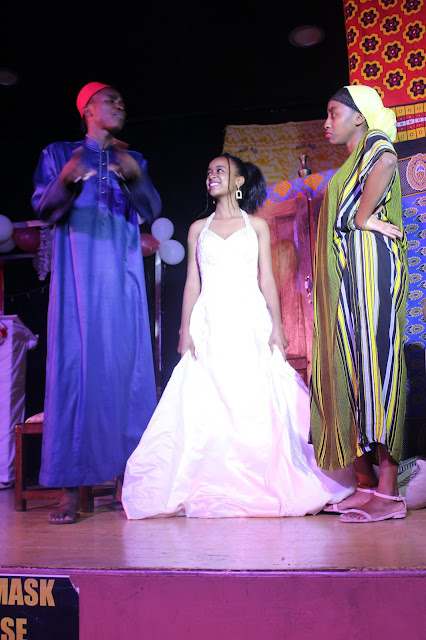
Quibbling among themselves ended as Cliff took charge to offer a toast to the new family arrangement. Unfortunately, someone had poisoned the wine that only Cliff drank. Now the scene cleverly switched into a murder mystery. Who would have wanted Cliff dead? Duke’s flamboyant style of having tried to grab his brother’s seat effectively set him up to be Suspect Number one.

Duke was right to protest that he was being set up. But no matter. While the stage got turned into a kind of family court, with Esquire serving as the presiding judge, Duke challenged all three critics, exposing the flaws of his mother, step-sister, and even the barrister. Nonetheless, the three ganged up on him. Thus, he was ‘charged’ and convicted for his brother’s murder, disowned from the family, and banished for good.

As soon as he left, something peculiar happened. The three were clearly co-conspirators, but the master mind behind what we had just watched turned out to be none other than who? Vanessa? Then, boom, Part 1 ends.

One assumes that the characters’ motivations will be clarified in Parts 2 and 3. But without even subtle clues suggesting that Vanessa is the wily witch that she would seem to be, one has to insist that Orina present us with the whole play next time. It is only fair to his audience.

CONTRACT LOVE NEEDED ZIPPY TO HELP HER STUDENTS OUT

               KU STUDENTS SHOWCASE THEIR MENTOR’S MUSICAL PLAY


By Margaretta wa Gacheru

Contract Love, staged last weekend at Kenya Cultural Centre by Kenyatta University students, is a play by Dr. Zippy Okoth that is one-part musical, one-part messy love story, and one-part murder thriller.

It’s got an interesting storyline, mirroring the plight of many school-leavers, the problem is finding a job to put bread on the table. Leave alone getting a senior position or a hefty wage. Anita (Judy Nyakio) is prepared to take any sort of work. She’s had to postpone completing her law course, the times are that tough.

Her sweetheart Tom (Andy Joseph) finds her employment as house-help to his uncle, Chris (Samson Adino). As humiliating as the suggestion might be, she agrees to take the job.

As it turns out Chris, a rich business tycoon, has a terminal disease, and behaves like grumpy old man. But Anita’s prepared to put up with anything, so long as she gets paid. In the course of six months, Chris’s health improves dramatically. Meanwhile, his business partner Harry (Jeff Opondo Omondi) wants to swindle Chris out of company leadership. He enlists Tom and tries to get Anita involved too. But she and Chris have already pledged undying love. What’s more, she warns Chris about the company contract that Harry has drawn up. But before the contract gets contested, Harry panics and the rest is a bloody mess, apart from Anita’s reunion with her old beau Tom.

It’s a story with so many twists and turns that it could have been a gripping show. Director Peter Oroto had assembled a number of excellent actors. The problem was that they needed at least another week of rehearsals. In that time, Oroto could have gotten his vocalists singing on key. He had a range of excellent voices, but they needed to take the tuning of their vocal cords more seriously,

Also, during that extra rehearsal time, the scene changes could have gotten tighter so the action from scene to scene could flow without the long lapses of darkness or silence that we witnessed last Sunday afternoon.

For instance, when the narrator told us the show would begin: ‘3-2-1’ and boom! Nothing happened except that in the dark, we could hear feet shuffling, chairs banging, and we wondered: Is the noise meant to be part of the show? It’s not.

The opening scene is in a night club where there’s an open mic, and Tom sings Anita a love song. The amorous hug that follows is meant to convince us that theirs is true love. But then, once she goes to work for grumpy Chris, we don’t hear or see him again for six months.

It’s during that time, apparently that Tom has been quietly corrupted and caught stealing cash from his uncle. Apparently, only Harry knows about it and plans to use that knowledge to blackmail Tom into helping him convince Chris to sign a new contract which would leave his company shares to him.

Tom (like Anita) has legal skills, and Chris counts on him as his legal advisor. Chris paid Tom’s school fees all the way through law school, so Tom’s loyalty is being sorely tested. He agonizes not only because he lost Anita carelessly, but also because he doesn’t want to betray his uncle. Harry detects his ambivalence and beats him up badly to convince him his life is on the line.

Before the story ends, there are two fatal shootings. But that’s the much of a spoiler I will be. The two gunshots are swift, efficient, and quite final. But they make the ending too easy, and also incomplete.

For instance, we don’t know what happens to the contract that Chris did or did not sign. If signed, would it be binding? What sort of impact would it have on Anita and the others left behind?

There is so much about ‘Contract Love’ that is intriguing and endearing. For instance, the impact that Anita’s presence had on the health of that lonely unwell bachelor is impressive. It’s also touching that both Chris and Anita have great news to share just moments before catastrophe hits in the form of Harry’s murderous money grab.

But the fact that the show ends with one last shot and the pregnant heroine Anita rushing back into the arms of her gun-totting old boyfriend Tom is a bit too Hollywood Wild Western style for me.

One word of advice: never take opinions of media critics too seriously! It’s not worth it.

BEATRICE & OKELLO BOTH HAVE ONE OFF SHOWS

 TWO ACCLAIMED KENYAN ARTISTS AT ONE OFF

BY Margaretta wa Gacheru (published 3 September 2021)

Having two of Kenya’s artistic giants on display at One Off Gallery at once is the opportunity gallerist Carol Lees affords the public this month through September 19. Beatrice Wanjiku and Anthony Okello are two of the brightest rising stars on the East African visual horizon and their shows at One Off reveal the rich diversity that our artists explore.

                                                                                  Okello's five lovely ladies

For Beatrice and Okello couldn’t be more different in their approach to painting. Leave alone that she works with acrylics and he with oils. Beyond that, their styles, subjects and the sentiments they interrogate in their art are radically different.

                                                                Beatrice's Untitled work at One Off Gallery

Beatrice goes straight to the core of our being, bypassing the superficialities and diving into the common features of being human, like bones, blood, veins and other guts. She has a way of striping her subjects down, literally to the bare bones so one has little choice but to journey with her into those interior parts.

Beatrice has taken us into those mental interiors in her previous shows. But often I’d felt I was heading towards a ‘heart of darkness’ where some inner sadness was revealed through her art.

But there’s a radical shift in the artist’s perspective in this show that she entitles “A wild infection of the wildly shaken public mind.” Now her means of dealing with a ‘wildly shaken public mind’ is to continue reflecting on the deeper challenges of being human. Only now, there is far more brightness, hope, and possibility in her art.

In her headlining show, there is one feature of the human form that repeats itself in multiple iterations. (Someone suggested her repeated forms reminded them of Monet’s multiple beach scenes which he painted and repaints at all hours of day and night.) And that is the ribcage. I find that an apt metaphor since Bea seems to be dealing with a delicate subject, namely, what it means to be safe and secure in these times of COVID.

Yet in a brief interview with the artist at her show’s opening, Beatrice said she began this body of work well before COVID-19 hit the world stage. “I began this series in 2018,” she confessed.

The ribcage itself is a protected zone, a brilliant structure designed to protect precious organs like the lungs, heart, and liver from events that could ‘shake the public mind’.

“For me, human bodies are a metaphor for mental frames of reference,” says Bea whose art seems to have a larger, more universal message. It is that irrespective of one’s skin, facial features, body size, or gender, the human condition is one that is shared by all.

Beatrice still prefers to work with darkened hues, especially shades of black and dark blue. But now, she also includes works where the brightness of her hues literally explode on her canvas. And as those explosions take place in works where pelvic bones are prominent, I had to ask what that light source was meant to signify?

“It’s about re-birth,” Beatrice says simply. “It’s also about hope and new possibilities,” she adds. With that major hint in mind, I begin to reevaluate my views of all her paintings. All have dazzling moments of brightness, be they yellow, bright orange, blood red or even white.

                                                                                                  Okello

The blood red might suggest violence, but for Bea, it would seem that the color affirms renewed life, energy, and power. 

She has a unique was of looking at the anatomy of the mind. For instance, in one painting, what appears to be positioned like a womb, is painted in blacks and blues. But Beatrice explains that all the growth inside the womb goes on in darkness, waiting for the time to be right, and a new being is born. But that’s another phase, another painting.

So when she says her work is about journeying in life, Bea is reclaiming a life of hope and rebirth, when darkness is only a bridge to something brighter and more full of possibility.

Okello’s art is also life-affirming. But rather than starting from a dark point and emerging into light, he has already arrived and found there’s time for self-reflection. But equally, there’s joy in looking at the beautiful and the absurd, the ironic and the elegant. His colors harmonize and his spirit soars in his art.

One final contrast between Okello and Beatrice is pricing. Hers run up into over a million while Okello’s run in the several hundred thousand.

THEATRE FOR ONE FEATURES 6 BRILLIANT ACTORS

                     DIGITAL ‘THEATRE FOR ONE’ TELLS KENYAN STORIES


By Margaretta wa Gacheru (posted 1 September 2021)

Thespians refusing to let their imaginations get lockdowned by the COVID 19 pandemic have come up with a whole new program for taking their theatre transnational, cross-cultural and Kenyan all at the same time.

“It’s all about collaboration,” says the Mombasa-born Karishma Bhagani who’s at the centre of the new Kenyan edition of a set of micro-plays entitled ‘Theatre for One: We are Here’,

The series of six one-woman plays will be performed live online from September 15th till the 27th, on Wednesdays, Saturdays, and Sundays. The six Kenyan women playwright-performers [whose original plays will premiere on the 15th] are Mumbi Kaigwa, Sitawa Nambalie, Aleya Kassam, Anne Moraa, Laura Ekumbo, and Mercy Mutisya.

The entire venture is the result of an ingenious collaboration ignited by Karishma and including a high-powered slew of award-winning Western thespians. They are Bill Bragin, executive artistic director of The Arts Center at New York University Abu Dhabi who actually commissioned the six ten-minute plays for Christine Jones’ Theatre for One, the experimental theatre company that Ms. Jones founded back in 2010. The venture is being produced by Mara Isaacs, founder of Octopus Theatricals of New York, and assisted by Kenya’s own Rainmaker Limited and Nairobi Theatre Initiative, both of which were founded by Sheba Hirst and Eric Wainaina.

Karishma’s role in making the Nairobi edition of ‘Theatre for one’ become a reality has been, as Bill Bragin put it in a zoom press conference last week, “a matter of trust.”

Bragin, who came from the acclaimed Tisch School of the Arts at NYU to launch the University’s Arts Centre at Dhabi, met the young Kenyan at a theatre conference just a year ago. But her enthusiasm for the theatre activities underway in Nairobi sparked his interest.

Karishma has been the executive producer for the Nairobi Theatre Initiative since 2019, which is how she’s so conversant with the artistic talents who are now in last minute rehearsals for their performances. She has also worked closely with Rainmaker Ltd. since it was Eric Wainaina who she initially met and who suggested she come on board as NBOTI’s executive producer.

At the time, Karishma was producing the Ugandan International Theatre Festival as well as completing her undergraduate studies at the Tisch School at NYU. But even then, she was keen to see Kenyan theatre transcend traditional boundaries and find transnational platforms on which to perform. Since then, she’s completed both a bachelor’s and master’s degree in theatre arts, and will soon be starting a doctoral program in theatre at Stanford University.

Nonetheless, she’s been able to juggle her time and undying devotion to Kenyan thespians who she has successfully linked up with some of the most dynamic and daring theatre producer-directors in the States.

At their press conference, Christine Jones admitted she was initially skeptical about taking ‘Theatre for One’ online. But the pandemic compelled artists like her to re-imagine the way they do theatre. “We want our audiences to feel a part of our performances,” she said.

There is little doubt that the six women artists who’ve been commissioned to perform this month from Kenya are among our best.

Karishman had worked most closely with three of the six who have been actively involved in creating musical theatre with the NBO Initiative. Aleya Kassam, Anne Moraa, and Laura Ekumbo (the LAM Sisters) have been working closely with Eric and Sheba for several years. The three also worked actively with Sitawa Namwalie in ‘Brazen’, which was an original script re-examining Kenyan history from a feminist perspective. Mumbi Kaigwa is a veteran woman actor, playwright, and producer-director whose original productions have won her international acclaim. And Mercy Mutisya is a rising star on the local theatre, television and film scene.

                               Aleya, Laura, and Moraa, the LAM Sisters are among the six actors in Theatre for One

Plus the six also work with dynamic women and men behind the scenes to perfect their performances. They include Nyokabi Macharia, Esther Kamba, the Damascus-born Kholoud Sawaf and the Yugoslavian-American director SRDA.

The original scripts they will be staging online are ‘The Interview’ by Aleya Kassam, ‘The Living Ghost’ by Mercy Mutisya, ‘Aging’ by Laura Ekumbo, ‘The Beanie’ by Mumbi Kaigwa, and ‘Killer Cop Lives Fast Life’ by Sitawa Nambalie.

The scripts address a wide range of diverse topics. The challenge to the actors is large, especially as all their rehearsals have been online, just as their performances will be. Accompanying the commissions from The Arts Centre of NYU Abu Dhabi will be workshops aimed at strengthening the theatrical skills of all the Kenyan artists.


Monday, 23 August 2021

GREENMAN COMBINES TRADITION AND MYTH WITH CONTEMPORARY ART

            GREENMAN COMBINES TRADITION AND MYTH WITH CONTEMPORARY ART


By Margaretta wa Gacheru (posted August 24, 2021)

Greenman is known among friends and fellow artists by that name only. Few people even question his ‘true identity’ since it’s the only name he answers to.

Yet Muleh Mbillo had a busy life before he found himself in a trance (or coma) and met the original Green Man years ago. In a chat with Weekender, he explains how this green man engaged him for several days, sharing so much wisdom that Muleh felt he wanted to be like him, wise, generous, and all-knowing.

Meeting a holy man in a dream didn’t feel out of the ordinary to Muleh. His family had introduced him to traditional seers or ‘mundu muue’ as they are called in Kikamba at an early age. “They also took me to see modern medical doctors, so I would know both traditional and modern practices. Then I could choose for myself,” he says. ”That’s why my meeting a [literally] wise green man in a dream didn’t feel peculiar to me,” he adds.

During DN LifeandStyle’s rendezvous with Greenman at Nairobi National Museum where he’s part of a group exhibition entitled ‘Disobedient Devices’, he explains more about his name.  “I didn’t just want to be like the green man. I wanted to be him, and that is how I acquired the name.”

Greenman shares the show with Joan Otieno of Warembo Wasanii, Moira Bushkimani of Brush tu Artists Collective and Dani Ploeger, a Dutch post-doctoral researcher from University of London. All four created art forms reminiscent of devices used traditionally in ritual practices. In addition, Joan, Dani, and Greenman created three short films to dramatize the way those devices were used historically. For instance, in ‘Reconstructive Prophesy’ Greenman takes on the role of a ‘mundu muue’ who uses his magical machine as a medium to receive divine counsel and then share it with his clients. In Joan Otieno’s ‘Medusa’s Coil’, it’s a snake that embodies powers her community traditionally revered. And in Ploeger’s The Cults’, the Dutch researcher dramatizes his interest in examining what he calls ‘the intersection between visual art and cultural studies in technology.’

The multimedia exhibition grew out of a connection Greenman made with Ploeger in 2016. “We’ve done several projects with Dani since then. Our current exhibition began with two workshops that took place in 2019,” Greenman recalls. “Those were attended by Joan and Bushkimani as well as several others.”

Among those others were several Western academics and artists who share Ploeger’s research interests. These have to do with trash and how Kenyans recycle waste into art. But more specifically, they were keen to understand how pre-colonial practices, traditions, and technologies could be reinterpreted in contemporary forms.

The challenge that the Dutchman posed to the Kenyans during the second workshop was to consider their cultural myths and traditional rituals as well as the technologies traditionally used to carry out those practices. Then let their imaginations go.

The fruits of that challenge are essentially what constitute the ‘Disobedient Devices’ exhibition. The three videos which were each scripted as science fiction by Greenman, Otieno, and Ploeger are being shown and repeated in a looped fashion, so one can watch all three in a matter of minutes once you reach the Creativity Gallery at the Museum.

The traditional technologies on display have been re-imagined and constructed’ using waste materials collected by the four exhibiting artists from the Dandora dumpsite where Joan normally scavenges all the ‘found objects’ used in her Warembo Wasanii studio in Ngomongo.

Greenman confirms that he made his traditional Akamba ‘technology’ from an old radio set that he found at the dump and then repainted using symbols he recalled from his first meeting with a mundu muue when he was a child.

“I was four years old when I went with my family to meet the mundu muue who performed a series of rituals and incantations for us. He also used his Nzevu (single stringed instrument) to create what I think was meant to be a spiritual bond between our family,” he says

That early encounter with a traditional seer never left Greenman, despite his studying mechanical engineering at Kenya Polytechnic. Instead, it led to his study of both traditional and mainstream religions and philosophies. Ultimately, that led him to translate his studies into the arts.

“I realized art was another way of tuning into Infinity,” he says. Art is also how he recreated the mundu muue’s mystical ‘radio set’ which is on display at the Exhibition.

Currently, Greenman is working with the Maasai Mbili Artists Collective.


NEXT GENERATION OF CONTEMPORARY AFRICAN ARTISTS AT CIRCLE ART

‘                  EMERGING’ EAST AFRICAN ARTISTS AT CIRCLE ART

            Seance by Sujay Shah at Circle Art Gallery

By Margaretta wa Gacheru (posted August 23, 2021)

In curating ‘Various Small Fires’ for Circle Art Gallery, Don Handah has defined an historic moment for a gallery that already has a tradition of bringing unknown (to the Kenyan public) artists from around the region to feature on its pearly white walls and floors.

In that same vein, Don has brought mainly Kenyan, but also Eritrean and Tanzanian artists to our attention in the gallery’s current show. But where he’s made something of a breakthrough is his choice to select young, relatively unknown artists, the kind who once might have been called ‘up-and-coming’. But ‘Small Fires’ features works that have been conceived by artists, mainly in the 20s, who are already creating works that are refined, polished, and purposeful.

                                                                                       Eddy Ochieng. The WAit II

Not that the 18 artists were ‘discovered’ by Handah. In fact, at least three of the Kenyans have already featured in previous Circle group exhibitions. They include Sujah Shah, Wanjohi Maina, and Florin Iki who, at 21 years, also happens to be the youngest of the lot. But the show does reflects Handah’s desire to assemble an exhibition that featured a fresh and fascinating variety of young artists’ works.

Admitting he had to do a bit of research to put it all together, I call his curating ambitious as well as risky business, because who knew if the public would appreciate his taste in relatively unknown painters, photographers, print-makers, and sculptors?

He has definitely assembled a mixed bag of media, techniques, subject matter, and genres. But those contrasts are one thing that gives the show its kinetic energy and power. For instance, at one end of the gallery, you will find four sassy women standing tall in the Eritrean painter, Nahom Teklehaimanot’s ‘My Beginning, my middle, my end’ 1. Meanwhile, at the other end and around a corner, you are unexpected struck by Sujah Shah’s playful dancers in his ‘Séance’. Both use deep, bold colors to capture the mood of their moments. Both bring an ineffable quality of vitality and energy that makes them come alive.


                                                                        Wanjohi Maina, Hawkers Republic XIII

Then there’s the hyper-realism of Eddy Ochieng, the figurative stoicism of Adam Masava’s and Wanjohi Maina’s everyday people, and the marvelous aluminum mannequins made by Austin Adika entitled ‘Butterflies and Roses’ (a series) and ‘Kaninja’

But in addition to all the figurative works, there are several abstract pieces in the show, like Anita Kavochy’s untitled works, Taabu Munyoki’s ‘’Does my hair make you uncomfortable’, Patrick Karanja’s Untitled etchings, and Tanzanian artist Winifrid Luena’s light-infused ‘Metamorphosis X which is a photographic print on paper.’

Even the textile art of Tanzanian Liberatha Alibalio’s piece, ‘Reflection 1’ might be considered abstract, but I personally admire it for its marvelous mix of textiles (satin and cotton) and techniques, such as stitching both by hand and machine as well as quilting to contrast the geometry of her appliqued forms.

                                                                                               Anita Kavochy, 

There are still-life’s in the show, like Wanini Kimemiah’s ‘Acetone Fire.’ And there are even surrealist works like Eritrean artist Nebay Abraha’s ‘Cobweb VIII and X’ which convey a sadness that might come from living in a land that’s seen too many years of war.

Handah clearly spent a good deal of time finding these artists. The internet must have helped, but given the relatively youth of these artists, he had to track a number of them down on foot.

I had seen some of their works in various places,” Handah told BDLife days after the show opened on August 11th “Some, like the Eritreans, sent us their portforlios, while I met others when I was visiting Tanzania,” he added.

                                                 Biniam Afewerki, The Longing Moment VI

But clearly, tracking down all of these young Kenyans took a determination to bring something new to the gallery where he’s been working for the last four years. Before that, he picked up curatorial skills with support of the Goethe Institute. He worked in several art venues after that, and even spent some time, on his way to early learning about the history of the Kenyan art scene, interning at Paa ya Paa Art Centre with Elimo and Phillda Njau.

Why I feel the ‘Small Fires’ show is special is because it introduces a number of emerging artists to a wider public, a public that is increasingly coming to appreciate contemporary Kenyan and African art, but may have gotten too comfortable knowing the so-called ‘established artists’.The 18 at Circle Art cannot yet be classified so easily. But all are on the move artistically. They are East African artists to watch.


Small Fires’ is up at Circle Arts until September 10th.

LIQUID ARTS PLAY ON INTER-ETHNIC WEDLOCK (OR WARFARE?)

                    INTER-ETHNIC WEDLOCK A TABOO OR NEW HOPE?

By Margaretta wa Gacheru (posted August 20th, 2021)

Peter Tosh has a taste for tackling troubling social issues in his plays, like the topic that doesn’t go away, namely ethnicity or tribalism.

His latest tale treats tribalism like a superbug that gets handed down from one generation to the next.

Technically, Kenyans are supposed to be over ethnicity. Or at least the younger generation are. Yet will the elders allow the youth to violate tradition and culture, or not?

These are the issues theatrically raised by Liquid Art’s latest production, entitled ‘Katiba’ which premiered last weekend at Kenya Cultural Centre.

Brill (Stephen Mwangi) and Vanessa (Nora Adisa) are intent on getting married and their wedding is just two days away. But there are heavy-duty family forces that are dead-set against it .

The most adamantly opposed is Uncle Tim (Felix Peter) who can’t even be persuaded by his clever wife Rose (Polyann Njenga) to let the youngsters alone. Instead, Tim threatens his nephew that on no uncertain terms will the wedding take place. He doesn’t disclose what his sinister scheme could be, but his hostility is clearly unsettling for Brill.

Vanessa also has her own ferocious naysayer in her mother, Rukia (Vivian Nyawira), who has similar ethnic arguments to Tim’s. They are reinforced once her father (Peter Tosh) arrives. He too is deeply committed to his culture and time-honored traditions. But he also blames Rukia for ‘underfeeding’ Vanessa who is skinny ‘like a mosquito’, a term similarly used as an insult by Tim.

What is clear is that Tosh is trying to show us that these ethnic stereotypes, especially those opposing cross-cultural marriage, are deep-seated beliefs. ‘Katiba’, the play’s title, is actually a metaphor for a new type of ‘c

onstitution’ being sought by the youth. In an interview that Weekender had with Tosh last Sunday, he explained his metaphor.

“Just as we fought for a new constitution, but the one we got turned out to be no better than the old one, so the new notion of relationships [based on monogamy and romantic love] may seem to be a new and better way of constituting marriage. But really, is it any better than what couples had before?”

While his perspective sounds somewhat cynical, the second half of the play reveals what he means. For as the wedding hour draws near, the lovers reveal their anxieties about their parents’ opposition to their plans. Both are deeply in love, but clearly when their families are so ferociously against them, they are in limbo about what to do.

That is when Uncle Tim bursts into Vanessa’s house (how did he know where it was?) and viciously attacks the girl. His taunts are not only abusive to the bride to be. They are literally terrorizing and scary.

But thereafter, what comes out in an exchange between Brill’s Pastor Ben (Majestic Steve) and Uncle Tim is that Tim had once loved Rukia desperately, and she had felt the same way toward him. But at one critical moment, they had a misunderstanding that each took to be intentional. They had planned a late-night rendezvous. But both got lost and didn’t meet. Each took the event personally and they never saw each other again. The bitterness of that ‘betrayal’ is what has fueled both Tim’s and Rukia’s opposition to their offspring’s wedding. They had once been brave enough themselves to cross tribal lines to fall in love. But it hadn’t worked for them, so they fell back into familiar tribal territory rather than to reconcile and be friends again.

The finale scene is the wedding which looks hopeful since Rukia arrives with her girl, head covered in kangas as is a custom in some cultures. But when the cloths are lifted, and after Brill has gleefully sung “Just the two of us”, it’s revealed that the bride is not Vanessa, but Uncle Tim’s choice, Salma (Mary Muthee). At that discovery, Brill faints and that is The End.

What I found most interesting is that the house-full audience, like myself, had no intention of applauding then. We were waiting for what we anticipated to be the final scene, when Brill would go for Vanessa and their ‘new katiba’ would begin, when as Brill explained, they would be making their own rules. But that last scene never came. So the ending is inconclusive, but disappointing all the same.

                             Peter Tosh, founder of Liquid Arts Production and playwright, author of Katiba, plays Guka

Just as Tosh said, as long as elders oppose inter-ethnic wedlock, and until there’s a radical change in perspective, mixed marriage may continue to be a taboo.