Sunday, 31 July 2022

HEARTSTRINGS’ WARNS: DON’T LET POLITICS DESTROY YOUR HOME

By Margaretta wa Gacheru (written July 29, 2022)

With ‘One Size Fits All’ Heartstrings Players didn’t just give us an ironic title of their latest comedy, given the divisive nature of political parties in families today.

They also gave us one of the most unanticipated endings that we have seen in a long time. The last words of many Heartstring plays are punchy and surprising. But in this case, the final revelation was so unexpected, my jaw literally dropped with what the brother (Tim Drissi) of Mama Sylvia aka Janet (Bernice Nthenya) had to expose.

What made that final twist even more explosive was the fact that emotions were already running high and getting hotter by the minute before Tim’s one-liner broke open the mystery that no one even knew about until a few moments before.

Storytelling by Heartstrings is almost always a collective creation. It comes together apparently by magic and usually works well. Cast members pick up the gist of what to say, not by having a script typed out in detail. It is more by virtue of the creative process being so memorable that the actors can’t forget their lines, however improvised.

But ‘One Size fits All’ didn’t ramble. Of course, there was the impulsive uncle of Sylvia (Adelyne Wairimu) who is prone to loud outburst of unsolicited opinion. But he’s a loveable fellow and clearly adores Janet’s only child. So does her dad (Paul Ogola) who is so devoted to her, he’s been known to weep for joy at her graduation ceremonies.

The eventful day that much of the play takes place in is filled with anticipation as Sylvia’s fiancĂ©, Jared (Pascal Otieno) is coming to meet her parents. Of course, he can never be ‘good enough’ for Paul’s daughter. And her dad’s brother Marko (Lawrence Murage) can easily make matters more difficult for the lad since he seems to delight in being a bully. Marko apparently came over as family and to see if he feels Jared is ‘worthy’ to be part of it. But he also comes to harangue his humble son Junior (Fischer Maina) who is at odds with his dad regarding his career and study plan.

Junior wants to study cosmetology, a course his dad poo-poos as manicures and cutex polish, not a manly topic like computer science. Dad is on the attack against the millennial generation for their obsession over issues like mental health and depression, and social media as a useful preoccupation. He lampoons young people like his son for thinking they have it rough in life but haven’t a clue what roughness really is.

Janet tries to intervene on behalf of Junior who looks meek and humble until the issue of politics comes up.. Then we see the central theme of the play, which is the divisive nature of today’s political scene and how it threatens to tear families apart over people’s intolerance of differing opinions.

In fact, once the topic crops up, and Janet and Junior don’t fall in line with Paul, we see all hell break loose. It’s just starting to get hot when Jared shows up and meets the brunt of misunderstanding which is fueled in a major way by Marko.

Nonetheless, Jared sticks around to see how ugly and poisonous political differences can get. The anger between Janet and Paul become so volatile that she finally proclaims a fact that is unbearably hurtful to Paul. Marko quickly picks up on Paul’s pain and throws Tim out of Paul’s house. Janet has already said she was leaving him, though she clearly wants to retract that statement as well as the painful one that followed it.

This play was long but nobody moved till we found out how the story ended. It finally did, in a courtroom where they were there over property. Marko was pushing for Paul to get everything, and the court ruled that way. But once the judge asked Sylvia to speak, she gave a moving acknowledgment of her dad, saying that whether she had Paul’s blood or not, he was still her dad and she adored him. Janet then spoke and explained why she had to use a surrogate to give Paul a child. The shocker, finally, came when Tim disclosed exactly who that surrogate was. I won’t tell since I want Heartstrings to bring the play back and talk more about Esther Kahuha’s comic return to the group as a pleasure to see.


CHECKMATE’ NEEDS AN EXTREME MAKE-OVER

Checkmate is a strategic term used in the game of chess to indicate the King’s being irredeemably cornered, attacked, and finished by any opponent of the King.

It can also be used as a metaphor to refer to anyone who is attacked and having no means of escape. In the case of Howard Lumumba’s play, ‘Checkmate’, the one getting checkmated is Kingston (Jera Etale) although we don’t know it until the end of the play.    

And oh, how very long it took to get to that point.

Characters like Wambugu (Prince Ianya), the landlord who normally carries all the keys, and particularly one that opens the way out of the Black and White estate was excruciatingly slow in answering neighbors who wanted him to open that door. In fact, he never had the nerve to tell them he didn’t have the key. But his beating around the bush got him tossed off the roof by Kingston. Nobody seemed to care, not even the cop who’d come to meet the area MP.

Wambugu wasn’t alone repeating his lines and dragging out stories until it got tedious. Getting to the point wasn’t something characters in Checkmate seemed willing to do. But one can’t really blame them.

We could also blame Howard Lumumba’s script or even his direction or both since he’s responsible for both. In fact, Checkmate is the perfect example of the peril one can get into when one person is both playwright and director of a play. On the one hand, we’d like to congratulate the writer for giving us his or her script. On the other hand, when one person is both writer and director, the danger is that there will be no one to edit the writer and no one to critique the director. So, if the text needs trimming or the action needs to be snappier or the dialogue more straightforward, none of that is likely to take place. Those were problems we saw in Checkmate.

It wasn’t a problem that most of the play took place as Kingston’s flashback. He’d been playing chess with his daughter Princess (Shirleen Njeri) and was explaining how it was important for her to have a backup –a plan B in her life. Otherwise, she might get into a fix as he did. Then he shifted into flashback.

We find ourselves in the Black and White slum where neighbors are bemoaning the state of affairs in Kenya today, especially the joblessness and high cost of living. When he arrives on the scene, he’s treated like a mad man because he is slightly craze. He has no money and his daughter requires school fees asap since she’s already two weeks late. We learn he might be one of the thieves who has been robbing grocery stores for food. So, it’s no surprise to see him on the roof of the tallest building in the slum, preparing to jump to his suicide since it seems to be Kingston’s only way out of experiencing a checkmate on his life.

The neighbors all have their own preoccupations, but they come together to beg him not to jump. On the other hand, when Wambugu arrives up there with him, the neighbors are so angry that he won't open the one way out of the slum, it feels like they might be ready to lynch him if they had to chance.

What apparently saves Kingston from both suicide and going to jail is the area’s candidate for Member of Parliament (Stella Muchina) who uses his situation as a propaganda tool and public relations trick. Kingston is treated like a charity case that she is helping. It’s her way of illustrating to her constituents that she can do it for one or many at the same time. It’s meant to show that she cares for the poor and is prepared to go all the way to help them out.

But then we come back to the present and discover the MP never kept her promise to Kingston. He’s still stuck and unemployed. What is worse is that his wife (Ann Njeri) plans to leave him and take Princess with her. So, in real time, Kingston is stuck and about to get checkmated. And that’s how the story ends.

Talk about a weak ending. The whole cast of neighbors had already walked off stage. Now it’s Kingston’s turn. But wait, there are so many loose ends that never get resolved. There's the fire that threatens to burn up Princess and the entrance-exit of the slum. There's the issue of whether blondie makes her 7pm blind date and whether her date will be Man 1 (Trevor Otieno). And there's the problem of how Kingston finally gets off the rooftop and onto solid ground.

What is clear is that ‘Checkmate’ needs an extreme make-over before it comes back on stage.

Tuesday, 26 July 2022

KOBO ARTISTS MESMERIZE VISITORS WITH ARTFUL STORIES

Mushrooms by Kobo Guest artist Elna Akware

By Margaretta wa Gacheru (posted July 25,2022)

Kobo Trust was alive with artistic energy this past weekend when all the artists working there held their second Open Day exactly one year after they organized their first Open Day in July of 2021.

It was a day that included not just a Group Exhibition in which all eleven resident artists displayed one painting each in the Trust’s Great Hall. There were exceptions made for the newcomers to Kobo, namely Iona McCreath, Aron Boruya, and this year’s Guest Artist, Elnah Akware, all of whom got a chance to show more than one of their works. The other exception was made for Onyis Martin’s three sculptures since he displayed just one painting, and the three were retrospective in nature and the only three-dimensional pieces in the show

 Paul Njihia

There was also a sale of artworks by the artists, including a 30 percent discount on the original sale price of the art. In this case, most of the works were slightly smaller, but the quality of the paintings was not diminished by the size.

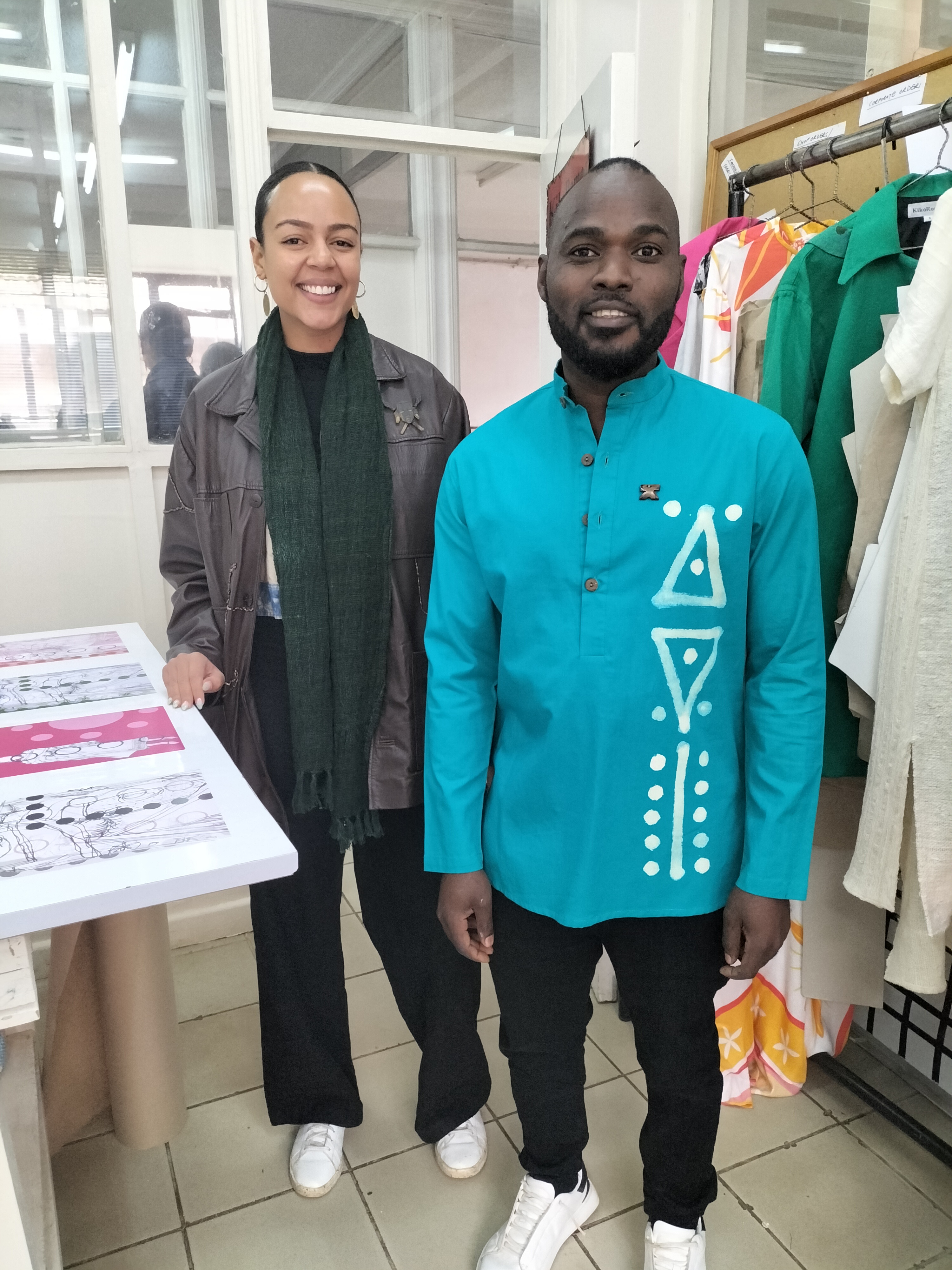
Then, as all the artists had their studios upstairs (apart from Iona McCreath who shares her space downstairs with her mother Ann and her chic African clothing company, Kiko Romeo), a trip upstairs was imperative to get the full feeling for the show.

That was where we found the energy flying high as visitors came upstairs to be spellbound by the artists telling stories about everything from their techniques to their childhood to the retrospective nature of much of their art. 


For instance, Onyis had to tell us why his papier mache boat was on the floor in the main exhibition hall.

“I was experimenting with different materials and concerned about the problem of migrants traveling from Africa trying to reach Europe,” Onyis tells BDLife. “The boat symbolizes the treacherous journey they take, and the rock-like pieces on the floor next to the boat symbolize those who died trying to migrate abroad,” he adds.

Timothy Ochola was also concerned about people looking outside themselves for a savior rather than seeing one within themselves. “That’s why I called my painting ‘Questions,’” says Ochola who, in addition to painting, teaches Landscape Architecture at Jomo Kenyatta University.

                                                                                          Tim Ochola

The exhibition features a number of university graduates, not all of whom graduated in fine art. For instance, Paul Njihia majored in Marketing and Commerce. But he’d been drawing since primary school. “I spent half my life in school, 16 years, so it’s no wonder I like to paint school children,” he says, referring to his painting entitled “Dining Hall, Prayer Day.” “With elections coming up, this is what they’ll be doing on that day,” he adds.

Kobo’s guest artist this year, Elnah Akware, also graduated from Kenyatta university, but unlike Njihia, she actually studied fine art. “I knew, by the time I got to secondary, I wanted to study Art and Music,” says Elnah whose dad backed her decision, including having her attend university. But her early years are the subjects of her woodcuts. “We used to eat mushrooms every morning before we ran to school,” she says, explaining why mushroom prints are in both the group show and the Open Day sale. A lover of fashion as well as furniture, Elna plans to have her own fashion house and furniture store in future. She’s got the passion and ambition to do both.

                 Iona McCreath, fashion designer with Kaloki modeling Kiko Romeo shirt hand-painted by El Tayeb

The other fashionista at Kobo is Iona McCreath who’s already created whole collections of unique garments. “My latest collection was inspired by Swahili culture using fabrics made out of things like orange peels and Lotus leaves,” says Iona whose concern for sustainability compels her create clothes with a social message.

Cyprian is a second-year university student who’s been having tutorials with Kenyan artists like Onyis ever since he was 14 years old. “I’d come study and paint with him on weekends and during school holidays,” says Rasto who, now 21, has already been in this year’s Venice Biennale alongside the likes of Njihia, Onyis, David Thuku (who is also at Kobo), and Michael Musyoka at the AKKA Gallery.

                                                       Rasto Cyprian's Self Portrait

Some of the other artists featured at Kobo’s Open Day included Onesmas Okamar (‘Empowerment’), Nadia Wamunyu (“Black Mirror”), Lemek Sompoika (“Identities”), Taabu Munyoki (“Rosemary Munyoki”), and David Thuku (“Red Room”), all of whom created figurative imagery in their art.

The one thing all twelve artists seem to share is their love for experimentation. As Onyis put it, “Experimentation is the only way to grow and discover the resources one has within one’s self.”

Taabu Munyoki's mom, Rosemary 


DAVID MULWA CELEBRATED


By Margaretta wa Gacheru (posted July 26, 2022)

David Mulwa is a living legend among thousands of Kenyans who have been blessed to be his students over the years. Best known for his roles on TV and film, his stage performances have been magnetic and have inspired countless youth to take up acting as a career simply for having seen and felt the soulful passion of this consummate performer and award-winning entertainer.

Yet Dr Mulwa has been equally passionate about his teaching in the Theatre and Film Department at Kenyatta University where he’s taught thousands of students the art of acting and the craft of creative writing. Scores of those appreciative Mulwa alumnae attended the Kenya Theatre Awards early this year where the elder statesman of the Kenyan stage received a Lifetime Achievement award for the huge body of artistic work he has performed, specifically in theatre, as not only an actor but as a director, producer, and playwright as well as a pedagogue and mentor.

It was the Chairman of the Kenya Theatre Awards and former Mulwa student, Benson Ngobia who invited all ex-Mulwa students to come on stage to congratulate their Mwalimu. The Kenya National Theatre stage veritably shook from the shock of so many Kenyans rushing up to greet Mulwa who many had not seen since their last class with him, except on national TV in series like ‘Family Affairs’, ‘Nairobi Law’ and ‘Heart and Soul’ to name a few.

“It was then that I began to think about organizing a gathering of his former students to pay Mulwa a visit,” Dr. Emmanuel Shikuku told BD Life at the event that finally occurred on Saturday, July 16th.


Mulwa was deeply moved by the receipt of the KTA award, but even more so by all his former students who appeared as if by magic on stage with him. What was clear on that occasion was that the ex-students were equally thrilled to be in the presence of the man who had mentored them when they had most needed assurance that their love of the theatre arts wasn’t a waste of time or a useless career pursuit in life.

“One thing I found most inspiring about Mulwa was the fact that he didn’t just talk about acting; he was also acting on stage or in film while he was teaching us,” said Sheila Masinde, one of the multitude who showed up at Mulwa’s new home in Ruia.

At age 77, Mulwa only retired from teaching in KU’s Theatre Arts and Film Department in 2021. He hadn’t been in perfect health for quite some time. Yet he never let the physical challenges he faced get in the way of his coming to class and teaching the Principles of Acting, Directing, Stagecraft, or Creative Writing. Nor did it stop him from acting in roles for Television or Film until recently.

Following the KTA awards night, Dr. Shikuku, who is also a former student of Mulwa (1999), went to see him at his home. That’s when he decided that the idea to plan a kind of ‘pilgrimage’ to their mentor’s home would be a pleasure not just for his students but for the man himself.

Shortly thereafter, a WhatsApp group was formed, inviting all the former Mulwa students to go together and see their Mwalimu. After that, the open invitation went viral and the numbers of Mulwa alumnae that joined the group soared. And even after Shikuku suggested that members of the group contribute to a fund to deal with the logistics of the meet-up day and another to donate for a gift to the Mzee himself, the numbers continued to grow and so did the donations. Funds even poured in from the Diaspora, from Europe and US.

“Ultimately we raised over Sh300,000 as our gift to Mwalimu Mulwa,” Dr Shikuku said. “That’s not including the additional Sh70,000 we raised to cover everything from tents and chairs to cooking utensils, 15 chicken and the sheep that we slaughtered and ‘choma-ed’,” he added, noting there was more than enough food. “It was a feast!” said Kevin Kimani, who’s now the Program Director at Kenya Cultural Centre as well as founder of the KIT Festival.

The plan originally was for there to be performances of some of Mulwa’s plays. But his students were so keen to share their feelings of affection and gratitude to the man that most of the day was spent with their taking turns telling how their Mwalimu had influenced and uplifted their lives.


Friday, 22 July 2022

IMAGINE ROTARY ART SHOWS TO END POLIO FOR GOOD

By Margaretta wa Gacheru (written July 22,2022)

DG Azeb Asrat launched her End Polio for Good Campaign in early August with the announcement of an Imagine Rotary Art Exhibition and Auction happening in November, from the 12th to the 26th. It will culminate during the Rotary Foundation dinner which she encourages Rotarians to attend.

The art exhibition will be a major fundraising event aimed at not only aligning our efforts with the Rotary International President’s theme to ‘Imagine Rotary’. It is to advance the Polio Plus campaign which RI initiated in the 1980s so successfully. Unfortunately, there are still small pockets of polio in several countries, which is why DG Azeb’s End Polio For Good campaign aims to give the final push to eradicate polio completely from the planet.

RI President Jennifer Jones has contributed to DG Azeb’s art exhibition in a major way, by sharing a fabulous painting, created by her brother, Darren, with the DG. The artwork to be auctioned during or just before the Rotary Foundation dinner will be a beautiful gold-framed print specially signed by the RI President.

Darren Jones, the RI President’s brother, is an acclaimed American artist whose works have been exhibited and collected all over the world. The work that DG Azeb plans to auction is entitled ‘Imagine One’s Dream’ and evokes a serene sense of radiant color, blended with an array of layered textures including everything from shredded paper and wood fiber to sand, plaster, and industrial staples. Hidden within the papers are words from the Four-Way Test meant to reflect the artist’s deep appreciation of Rotary.

The wider art exhibition will include paintings by artists from District 9291 countries, namely Eritrea, Ethiopia, Kenya, and Sudan as well as from other countries in the region such as Uganda and Tanzania. And because DG Azeb’s vision of Ending Polio embraces the whole world, she invited artists everywhere to apply to be part of the exhibition.

The location of the exhibition and auction have yet to be finalized but they are likely to be in the City Centre of Nairobi in one of the city’s leading Hotels.

Simultaneously with the Nairobi exhibition, DG Azeb is also planning to have a fundraising Art Exhibition in Addis Ababa, organized by one of that country’s leading gallerists and curators. The rationale for having the second art exhibition is the same as the Nairobi show. It is to mobilize resources which will enable countries to vaccinate the most vulnerable in the society, namely the children. Imagining a world free from this disabling disease is a dream the DG wants to see come true.

The DG has been considering various strategies to enable all Rotarians in the district to contribute to this worthy cause, especially as it will amplify Rotary’s role in initiating the highly successful Polio Plus campaign. One proposal is to open an Imagine Rotary Art Account and everyone who contributes Sh50,000 would be entitled to one of any number of designated artworks in the show. Further details to follow in the September DG Newsletter.


Sunday, 17 July 2022

BIBLE DRAMATIZED BY OUR BEST


 It’s tempting to suggest you won’t enjoy ‘Voices of the Bible: Kings and Leaders’ nearly as much if you don’t have a slight grounding in the Bible, especially the Old Testament.

If you haven’t read about the trials and tribulations of men like Moses and Jeremiah or even John, who was exiled on the island of Patmos, then you won’t understand how brilliant Gillette Elvgren’s script is.

But if you love watching sterling performances by some of Kenya’s finest actors alive on our stage and screen today, then you won’t want to miss “Kings and Leaders’ because these are the leading roles they play.

In fact, scriptwriter Gillette specifically focuses on the leading men in numerous scriptural tales. He amplifies their innermost feelings as they reflect on their lives, and the reasons they are in the Bible in the first place.

In Moses’s case, it’s to deliver God’s chosen children out of bondage in Egypt into the Promised Land which he is destined not to reach himself. In the case of the prophet Jeremiah, it’s to lament the children of Israel’s neglect of their God and the tragic times they’ve gotten themselves in because of that forgetfulness of the blessings they received from Yahweh, their name for God.

And John’s the one who wrote those scary bits in Revelation, the meaning of which scholars have been trying to understand for centuries, especially what he ultimately sees in ‘a new heaven and a new earth’.

But even if you haven’t a clue about what happened to guys like Aaron (Sam Psenjen) or Eli (Steve Katingima) or even Uriah (William Mwangi) who dies so masterly on stage, declaring his loyalty to King David who’d just had him killed to conveniently snatch his wife), they all gave spellbinding performances. And most everyone (even heretics and atheists) will have heard about Adam (Elsaphan Njora), Moses (Justus Mirichii), and Paul (Mugambi Nthiga), all of whom were equally riveting in their roles.

                                                                                   Elsaphan Njora


The lighting at Braeburn Garden Estate isn’t the best for this type of production. But sound-wise, the eight actors brought together in this Chemi Chemi Players production harmonized melodiously in acapella style on everything from popular Swahili hymns to one Black American gospel song to the show’s culmination with a deeply moving performance of Kenya’s National Anthem.

In fact, ‘Kings and Leaders’ is the kind of show that sticks in one’s head long after you watched it. It leads you to appreciate how deeply the scriptwriter delved into the innermost thoughts of those key characters. Of course, it can be seen as fiction since she didn’t know any of her characters personally.

But take a guy like Adam (Elsaphan Njora) who’s mainly remembered as the guy responsible for ‘the original sin’ of disobeying God. Elsaphan explores the loneliness that ‘first’ mortal man must have felt, having no one to talk to but Eve. That same reflective, soul-searching point of view is seen in almost all the characters. They include everyone from Pharaoh (Kevin K1 Maina) who lost his first son, to Eli (Steve Murage) the priest who also died on stage after confessing his ‘sin’, that of envy over young Samuel’s hearing the word of God directly, not him.


                                                                               William Mwangi

Yet the play has several surprisingly funny scenes, like the reenactment of a light-hearted Sunday School Biblically-based performance of the cast playing school boys overdramatizing their roles. It started with Purah (Mugambi Nthiga) who drew us into his enchanting childhood recollection of his Sunday School reenactment of the story of Gideon (William Mwangi) and the angel (Kevin Maina) from the book of Judges.

The other comedic moment was captured by Sam Psenjen playing Matthew, the tax collector whom Jesus picked to follow him. Previously only seen as a corrupt tax man, even by Jesus’s own disciples who were shocked at their master’s selection, Matthew was philosophical in his light-hearted appraisal of how many ways people cheat themselves, and even cheat God.

Kings and Leaders is very different from Chemi Chemi’s previous production of the all-women show, “Spread your Garment over me’ which projected the lives and feelings of women characters in the Bible. The latter was a slightly more accessible script. But the quality of the casts and the direction by Julisa Rowe are the same.

                                                                                    Mugambi Nthiga

What’s also amazing about this production, which will be running again this weekend (so don’t miss), many in the cast have moved over to making films. So, we’re happy to see them back on stage.


A CHEATERS’ GUIDE ILLUSTRATED


BY Margaretta wa Gacheru (written July 17, 2022)

‘How to have an Affair: A Cheaters’ Guide’ is a scandalously funny two-hander, co-starring Nice Githinji and Charles Oudo, directed by Nyokabi Macharia.

Having such a suggestive title, you might think the show would attract house-full audiences every night, especially as it was staged at Ukumbi Mdogo. And you’d be correct.

It was the debut of the play which was adapted and indigenized by ‘Shorts from Africa’, the theatre company that’d essentially devised the script, having drawn from an array of sources. But it was also the debut of Shorts from Africa, which was started by Nice and Nyokabi who began working together during COVID.

“We both were part of an experimental online theatre project that brought together actors from all over the world,” says Nyokabi, citing the project’s organizers as Balcony Arts. Their second project was entitled Shorts Around the World which is what spurred the two women on to create Shorts from Africa and later develop “a cheaters’ guide”.

The show takes you inside the heads of two married individuals as they illustrate exactly how ‘it’ is done, how to have an affair and effectively cheat on the other interested parties effectively. That might sound like a shockingly salacious premise on which to formulate a play. In fact, the eroticism itself, suggested in the title, could be titillating and tantalizing to others.

As it turns out, the play is both salacious and erotic yet cerebral and thought provoking. Kendi (Nice) initially raises the salient question, why do women risk everything to chase men they know they will never marry? Similarly, Harun (Charles) raises the disturbing question asking why men screw around at all?  Could it be as simple as Harun suggests? He claims he has screwed countless women simply because he can and because he loves women. What in his case has been troubling is the question, why do men stop screwing around which is a more unusual problem that he’s apparently confronted with in A cheaters’ guide.

Well, not exactly he’s definitely waylaid from cheating on more than one after his encounter with Kendi.

Initially, Harun takes up his habitual role of charming Casanova who’s an expert in the art of seduction. We watch their wooing game where she looks befuddled and easy prey, and he looks confident in turning on the sexy charm that normally knocks them out every time. But in Kendi’s case, after two or three casual yet evocative meetings, she drops all pretenses and tells him plainly she has the afternoon free and basically available to him.

The next scene is the high point of sexual ‘shock and awe’; of hilarity and the unexpected. It’s a shocker to see Kendi being so candid, aggressive, and insatiable all at once. It’s also awesome because it’s so cleverly handled by the set designer Muthoni Gitau and the director Nyokabi Macharia. They fabricate the glossy white translucent curtain behind which Kendi and Harun have their first intimate encounter that gets hot, hotter, hottest with Kendi apparently the aggressor and intoxicator of Harun who doesn’t know what hit him.

Speaking of set design, Muthoni assembled a beautifully modern set complete with an upright mattress and pillows that lend a much more ‘innocent’ portrait of what goes on between the couple. Even the foyer of Ukumbi Mdogo got a makeover by ‘Shorts from Africa’ as there was seating for early birds who’d never before found a place to sit while waiting for the theatre doors to open wide.

In the final analysis, it’s the acting that makes the Cheaters’ Guide such a marvelous performance. Taking on such a delicate topic with sensitivity that tells a story that is rarely revealed. It is what actually happens in terms of the rise and fall (pun intended) of relationships, sexual liaisons that can never work because the initial passion and pleasure never be sustained with the same intensity as that initial hook-up. It can never elicit the same adrenaline that ran rapidly through the cheaters’ veins during that first ‘close encounter’.

Also, the cheaters’ fling can rarely retain the commitment initially implied or hoped. Anyone who thinks otherwise is sadly deluded. Not that marriage is the only alternative, but when there are children involved, it’s hard to keep that ‘pango wa kondo’ if you have even a small sense of responsibility for the children’s lives.

Kendi ultimately gives up on Harun because she finally sees how he’s increasingly putting his family’s needs before her own. How could it be any other way?


                                                                        Nyokabi Macharia, director